Visual Effects
Using nerfies you can create fun visual effects. This Dolly zoom effect would be impossible without nerfies since it would require going through a wall.
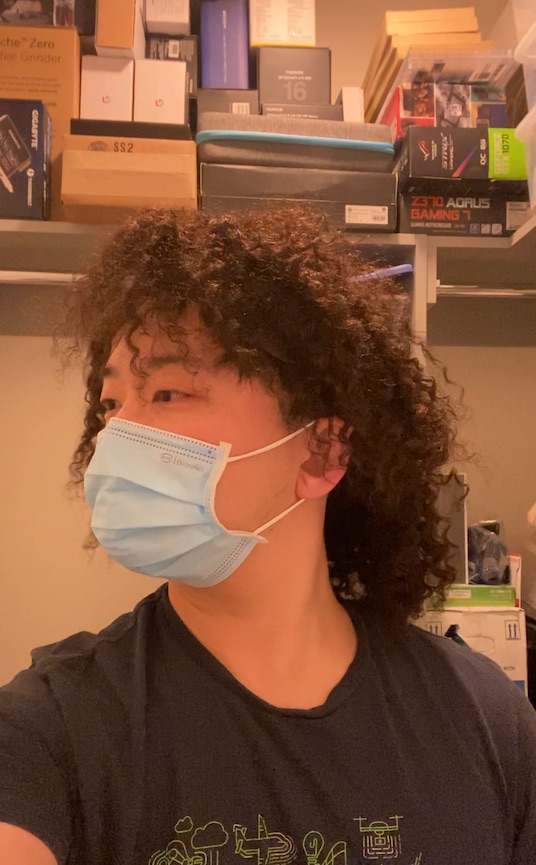
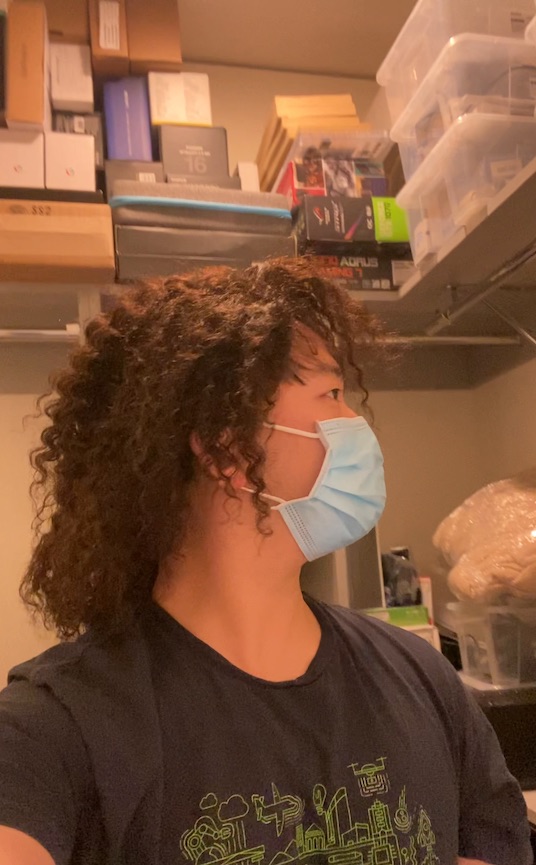
We present the first method capable of photorealistically reconstructing a non-rigidly deforming scene using photos/videos captured casually from mobile phones.
Our approach augments neural radiance fields (NeRF) by optimizing an additional continuous volumetric deformation field that warps each observed point into a canonical 5D NeRF. We observe that these NeRF-like deformation fields are prone to local minima, and propose a coarse-to-fine optimization method for coordinate-based models that allows for more robust optimization. By adapting principles from geometry processing and physical simulation to NeRF-like models, we propose an elastic regularization of the deformation field that further improves robustness.
We show that Nerfies can turn casually captured selfie photos/videos into deformable NeRF models that allow for photorealistic renderings of the subject from arbitrary viewpoints, which we dub "nerfies". We evaluate our method by collecting data using a rig with two mobile phones that take time-synchronized photos, yielding train/validation images of the same pose at different viewpoints. We show that our method faithfully reconstructs non-rigidly deforming scenes and reproduces unseen views with high fidelity.
Using nerfies you can create fun visual effects. This Dolly zoom effect would be impossible without nerfies since it would require going through a wall.
As a byproduct of our method, we can also solve the matting problem by ignoring samples that fall outside of a bounding box during rendering.
We can also animate the scene by interpolating the deformation latent codes of two input frames. Use the slider here to linearly interpolate between the left frame and the right frame.
Start Frame
End Frame
Using Nerfies, you can re-render a video from a novel viewpoint such as a stabilized camera by playing back the training deformations.
There's a lot of excellent work that was introduced around the same time as ours.
Progressive Encoding for Neural Optimization introduces an idea similar to our windowed position encoding for coarse-to-fine optimization.
D-NeRF and NR-NeRF both use deformation fields to model non-rigid scenes.
Some works model videos with a NeRF by directly modulating the density, such as Video-NeRF, NSFF, and DyNeRF
There are probably many more by the time you are reading this. Check out Frank Dellart's survey on recent NeRF papers, and Yen-Chen Lin's curated list of NeRF papers.
@InProceedings{Jang_2023_ICCV,
    author    = {Jang, Youngkyoon and Zheng, Jiali and Song, Jifei and Dhamo, Helisa and P\'erez-Pellitero, Eduardo and Tanay, Thomas and Maggioni, Matteo and Shaw, Richard and Catley-Chandar, Sibi and Zhou, Yiren and Deng, Jiankang and Zhu, Ruijie and Chang, Jiahao and Song, Ziyang and Yu, Jiahuan and Zhang, Tianzhu and Nguyen, Khanh-Binh and Yang, Joon-Sung and Dogaru, Andreea and Egger, Bernhard and Yu, Heng and Gupta, Aarush and Julin, Joel and Jeni, L\'aszl\'o A. and Kim, Hyeseong and Cho, Jungbin and Hwang, Dosik and Lee, Deukhee and Kim, Doyeon and Seo, Dongseong and Jeon, SeungJin and Choi, YoungDon and Kang, Jun Seok and Seker, Ahmet Cagatay and Ahn, Sang Chul and Leonardis, Ales and Zafeiriou, Stefanos},
    title     = {VSCHH 2023: A Benchmark for the View Synthesis Challenge of Human Heads},
    booktitle = {Proceedings of the IEEE/CVF International Conference on Computer Vision (ICCV) Workshops},
    month     = {October},
    year      = {2023},
    pages     = {1121-1128}
}